
Ads in AI Mode are coming to the UK: what you can control
Google is expanding ads in AI Mode, the conversational search experience in Google Search. On 28 October 2026 it announced ten more countries and said that further markets, including the United Kingdom, Brazil and Mexico, are planned for Q4 2026. If you advertise to UK shoppers, your existing campaigns will take part without you doing anything.
That is the important part. There is no new campaign type to launch and no setting to switch on, or off.
Where ads in AI Mode run today
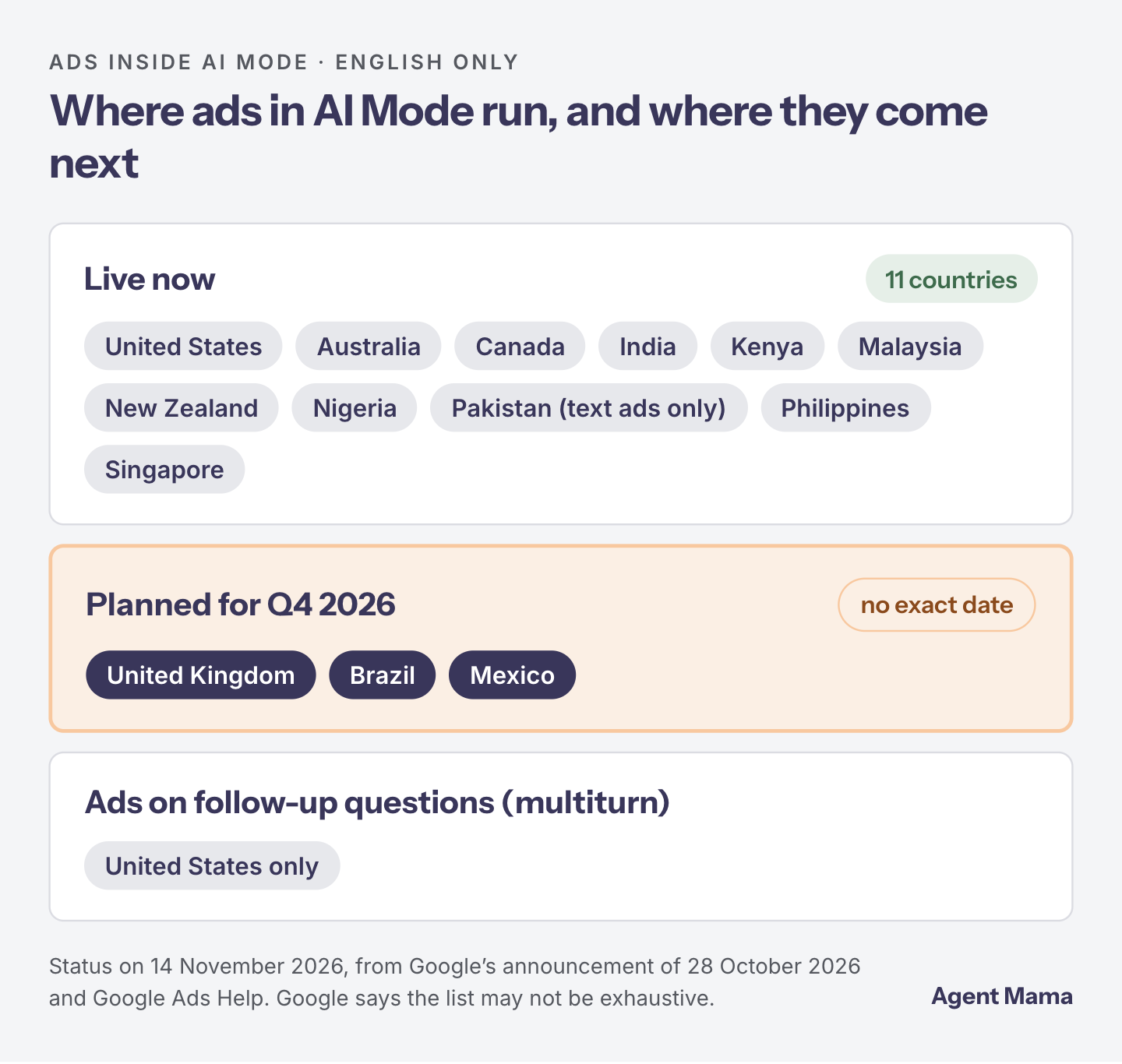
Ads inside AI Mode are served in English only. Google has given no exact date for the Q4 markets and has named no other European country. Ads on follow-up questions in the same conversation, which Google calls multiturn ads, are launching in the United States first.
How your campaigns take part
Existing Search, Shopping and Performance Max campaigns are automatically eligible. Text ads and Shopping ads can appear, labelled “Sponsored”, inside or alongside the AI answer. They enter the same auction and are billed in the same way as other Search ads.
What differs is how an ad is matched. Google describes two routes:
- Direct matching. The search already shows commercial intent, and the ad is matched to the query as on a normal results page.
- Contextual matching. Someone asks a longer, exploratory question. The ad is matched to the question and to the AI answer, where a product becomes the natural next step.
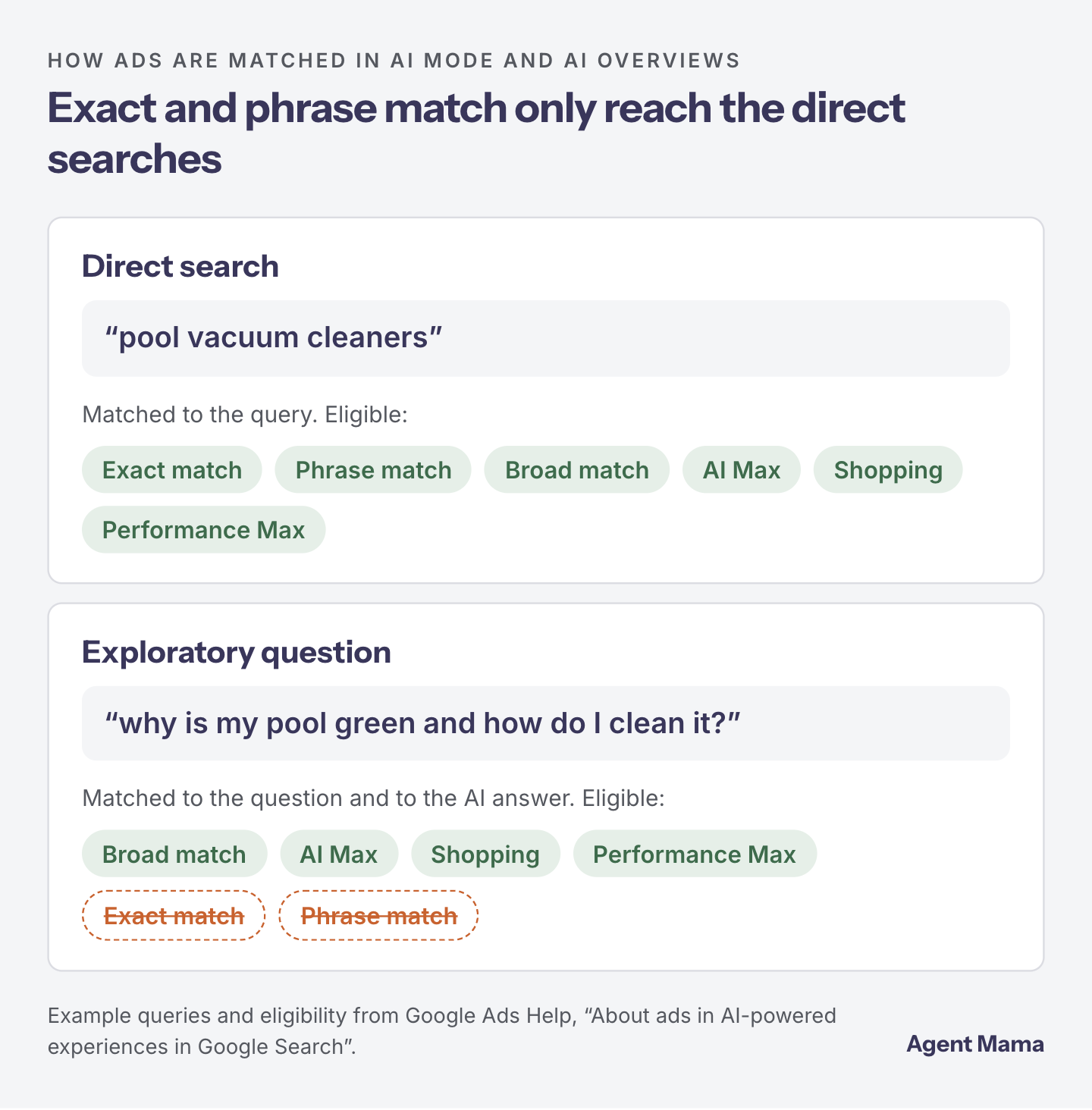
Exact and phrase match keywords only take part in the first route. Broad match, AI Max for Search, Shopping campaigns and Performance Max take part in both. Google reports that queries in AI Mode are on average three times longer than traditional searches, so the exploratory route is not a marginal case.
What you can and cannot control
| Question | Answer |
|---|---|
| Can we opt out of AI Mode or AI Overviews? | No. They are part of Google Search. |
| Can we target only AI Mode? | No. |
| Can we see performance separately? | No. The figures are included in aggregate in campaign reports and the search terms report. |
| Do negative keywords and brand exclusions apply? | Yes. |
| Does asset pinning apply? | Yes. |
| Can we edit the AI explainer shown next to an ad? | No. It is written by Google’s model and cannot be edited, approved or switched off. |
The last row deserves attention. In some placements Google adds a short AI-written explanation of how an ad relates to the question. It draws on the query, the AI answer and public sources, including your own website. You do not write it, but your product pages are among the things it is written from.
What this means for profit
You are about to buy more clicks from people who are still working out what they need. Some of them will become customers you would not otherwise have reached. Others will read, compare and leave. Both groups arrive through the same campaigns, at bids set by the same strategy, and you will not be able to separate them in a report.
That makes the quality of your conversion value more important than before. If bidding is steered by revenue, an exploratory click that ends in a discounted or returned order looks as good as a profitable one. If it is steered by what an order contributes after costs and returns, the system has a reason to tell them apart.
It also shifts some weight from keywords to source material. In contextual matching, your product feed and your pages do the work that a keyword list used to do. Thin titles, missing attributes and vague product pages now cost reach, and may shape what the explainer says about you.
We would not rebuild an account for this. We would make sure the inputs are sound and that there is a baseline to compare against.
What to do before it reaches your market
- Record a baseline now. Save the search terms report and the main campaign figures for your UK campaigns, so that a change in query length and mix is visible afterwards.
- Check which campaigns can match exploratory questions. If everything is on exact and phrase match, you only take part in direct searches. Decide whether that is intended.
- Tidy the product feed. Descriptive titles and descriptions, several good images, correct prices, and clear delivery and return terms.
- Read your product pages as source material. Are the facts a shopper asks about stated plainly on the page?
- Review negative keywords and brand exclusions. They are the controls that still apply.
- Check what your bidding is optimising towards. Broader matching rewards an accurate value signal and punishes a rough one.
Ads are one side of AI search. The other is whether AI systems may use your pages at all, which is decided in a different place: see the planned AI training opt-out in robots.txt. And because product images matter more in these placements, check which images Performance Max is allowed to pull from your pages.
If you want to see what your campaigns earn after costs and returns, book a demo.
Sources
- Ads in AI Mode expand to new markets. – Google Ads & Commerce Blog, 28 October 2026
- About ads in AI-powered experiences in Google Search – Google Ads Help, read 14 November 2026