
AI training opt-out in robots.txt: what a shop should decide
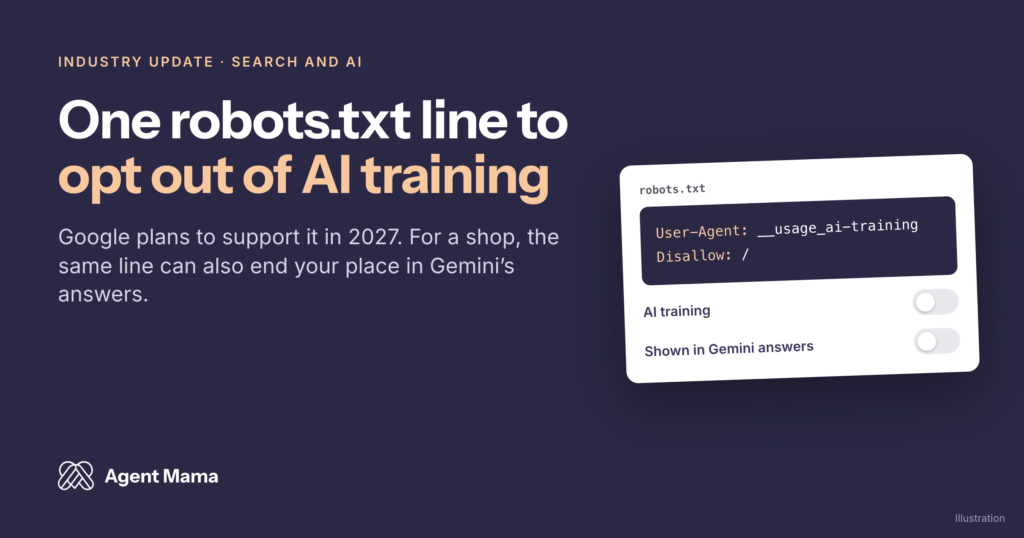
On 30 October 2026 Google said it plans to support a shared AI training opt-out in robots.txt: one line that tells every participating AI provider that a site does not want its content used to train generative models. Google aims to support it during 2027. Nothing is live yet, and nothing needs to change on your site today.
It is still worth understanding now, because the line looks harmless and, for a shop, it is not a neutral choice.
What is planned
Today each AI company has its own instruction. Google’s is called Google-Extended and has existed since 2023. The new control is a single “policy token” written like an ordinary robots.txt group. It comes from the IETF working group on AI preferences, and the draft was published on the same day as Google’s announcement:
User-Agent: __usage_ai-training
Disallow: /
The draft adds no new syntax. Paths work as they always have, so a site can opt out as a whole and allow a single folder. The token expresses a preference about how content is used. It is not an instruction to crawlers, and rules for ordinary crawlers keep working exactly as before.
Three controls that are easy to mix up
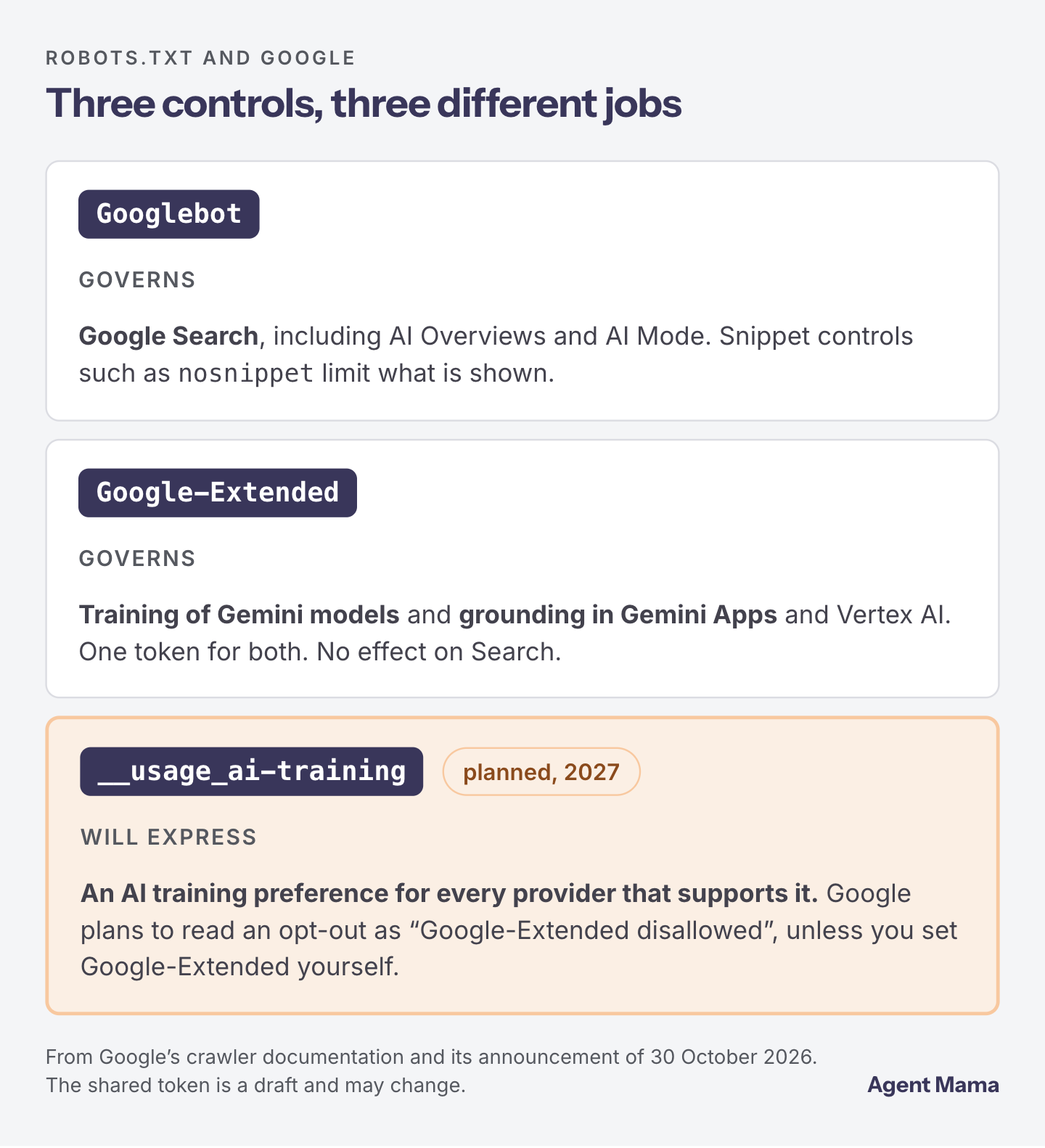
The differences matter more than the names suggest.
- Google Search is not involved. AI Overviews and AI Mode are part of Search and follow your rules for Googlebot and your snippet controls. Google-Extended has no effect on whether you are included in Search and is not a ranking signal.
- Google-Extended covers two things at once. It governs whether your content may be used to train Gemini models, and whether it may be used for grounding, which is how the Gemini app fetches current content to answer a question and link to it.
- The shared token will be read as Google-Extended. If a site opts out with the shared token and says nothing specific about Google-Extended, Google plans to treat that as if Google-Extended had been disallowed.
Why this matters to a shop
Put the last two points together. A shop that adds the shared opt-out, and nothing else, will in Google’s case also have withdrawn from grounding in the Gemini app. Google states the other side of this plainly: sites that specifically allow Google-Extended are eligible to appear in responses and receive clicks through grounding in Gemini Apps.
A publisher that lives on its articles has good reasons to weigh this differently. A shop’s content mostly exists to be found: product facts, buying guides, sizing help, delivery terms. Being left out of an assistant’s answer is rarely what a shop wants.
There is one more constraint. With Google you cannot currently allow grounding and refuse training. One token covers both. A shop that wants to stay eligible in Gemini has to accept both.
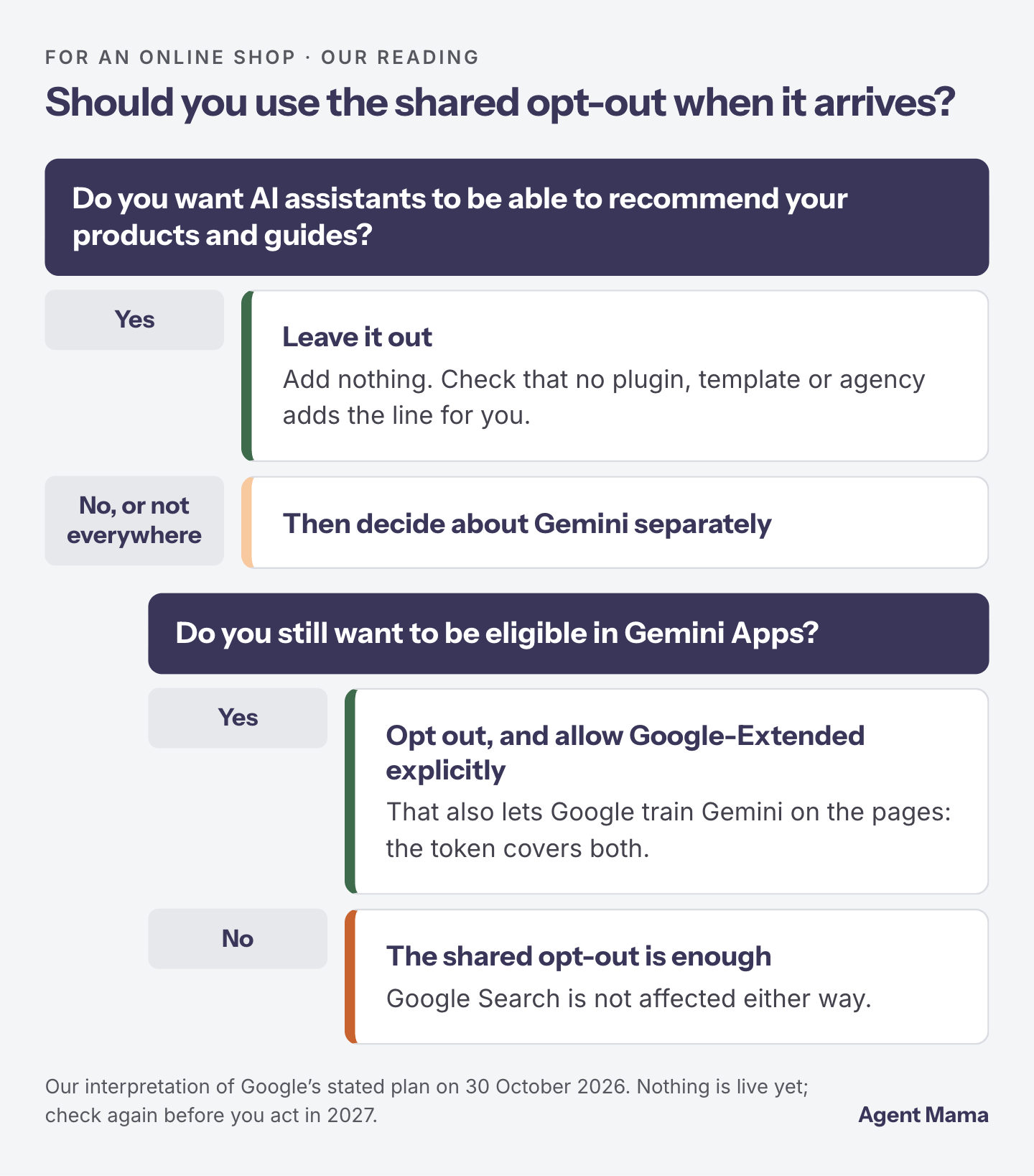
If you do want the general opt-out and still want to be eligible in Gemini, the combination would look like this. It rests on Google’s description of its plan and on a draft, so treat it as an illustration and check the final documentation before using it:
User-Agent: __usage_ai-training
Disallow: /

User-Agent: Google-Extended
Allow: /
What this means for profit
Nobody can yet say what a place in an AI assistant’s answer is worth to a given shop. The traffic is small for most, and it is hard to measure. That is an argument for keeping the option open, not for closing it by accident.
The risk here is not the decision. It is the decision being made by someone who was thinking about something else: a developer copying a recommended robots.txt, a plugin with a new “protect my content from AI” switch, a legal review that treats a shop like a newspaper. Each of those is reasonable from where that person sits, and none of them is weighing discovery against protection.
So the useful step is small. Decide who owns this choice, write down what was decided and why, and make sure a change to robots.txt cannot go live without that person seeing it.
What to do now
- Read your current robots.txt. Look for Google-Extended and for other AI crawler rules. Many sites have blocks that nobody remembers adding.
- Decide your position before 2027. For most shops we would leave the shared opt-out out. If you have content worth protecting, such as original photography or editorial work, consider opting out for those folders only.
- Name an owner for robots.txt and record the decision.
- Ask your platform, plugin and agency whether they plan to add the token by default.
- Check again when Google confirms support. The draft may change before then.
Google Search follows its own rules, and that includes the paid side. Ads now appear inside AI answers as well: see what you can control when ads in AI Mode reach your market.
If you want to see how decisions like this are followed up against profit, book a demo.
Sources
- Supporting a shared AI training control for websites – Google Search Central Blog, 30 October 2026
- Google’s common crawlers – Google Crawling Infrastructure documentation, read 14 November 2026
- Machine-Readable Training Preference Signal (draft-kelley-aipref-training-preference-signal-00) – IETF Datatracker, 30 October 2026
- AI Features and Your Website – Google Search Central documentation, read 14 November 2026